Schuler Capital Management LLC
  • Home
  • Approach
    • What Makes Us Different
    • How We Work With Clients
    • About Us
  • Risk Model
    • Safeguard 1st Risk Model
    • Why Does It Work?
    • Risk Management vs Market Timing
    • Key Takeaways
    • What Is Safeguard 1st Telling Us Now? >
      • Current Safeguard 1st Signals
  • Reasons Why
    • Buy & Hold May Not Always Be Best
    • The Achilles Heel of the 60/40 Portfolio
    • Is Your Portfolio Really Diversified?
    • Cash Is Not Trash
    • Fees Matter
    • What To Know About Track Records
  • Home
  • Approach
    • What Makes Us Different
    • How We Work With Clients
    • About Us
  • Risk Model
    • Safeguard 1st Risk Model
    • Why Does It Work?
    • Risk Management vs Market Timing
    • Key Takeaways
    • What Is Safeguard 1st Telling Us Now? >
      • Current Safeguard 1st Signals
  • Reasons Why
    • Buy & Hold May Not Always Be Best
    • The Achilles Heel of the 60/40 Portfolio
    • Is Your Portfolio Really Diversified?
    • Cash Is Not Trash
    • Fees Matter
    • What To Know About Track Records
Standard Deviation 
 
Standard deviation is a measure of the dispersion of a set of data from its mean (its average).  
 
Conceptually, the standard deviation is just a measure of volatility:  it measures the amount of uncertainty or risk by quantifying the size of changes in a security's value versus its average value.  A higher standard deviation means that a security's value can potentially be spread out over a larger range of values.  This means that the price of the security can change dramatically over a short time period in either direction.  A lower standard deviation means that a security's value does not fluctuate dramatically, but changes in value at a steady pace over a period of time.

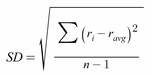
It is calculated as the square root of variance by determining the variation between each data point relative to the mean. The more the individual data points stray from the mean, the higher the standard deviation and, therefore, the higher the risk.  A formula is provided below for the more mathematically minded.
Picture
Disclosures & Backtesting Results Disclaimer
Contact
Legal
Privacy Policy
Internet Communications Notice